01 ·
Valid accounts
T1078, credentials stolen via helpdesk vishing, MFA bypass through push-bombing. No malware, no signature: just one extra operator with the right credentials.
Fortgale delivers a threat intelligence-driven Managed Detection and Response service, operated by a European SOC active 24·7·365. The service integrates with the security platform your organisation already uses, with no vendor lock-in. The techniques of 287 hostile tools and actors targeting European organisations are translated into detection rules before the attack reaches your infrastructure. Artificial intelligence, built into the detection and response cycle, filters and correlates alerts: our analysts focus on real threats and retain control over every response decision. The result is median containment <30 min from confirmed alert and active defence from the first days of onboarding.
Fortgale MDR is a managed security service: European analysts watch your telemetry around the clock, validate every alert and contain the attack on your behalf. If you need the basics first, read what MDR security is and how it works. The service is vendor-agnostic and runs on the platform you already use. The proprietary CTI behind it tracks 287 adversary groups and attack tools: that intelligence inside the defence lifecycle is what we call MDIR, Managed Detection, Intelligence and Response.
| Model | Who operates | Who responds | Coverage |
|---|---|---|---|
| Fortgale MDR | Analysts in a European SOC 24·7·365 | Yes: they contain on your behalf | Endpoint, identity, cloud, network |
| MSSP | Provider staff, often device management | Usually notification, you act | Devices and logs it manages |
| EDR / XDR alone | Your team | Only if your team is awake and available | The vendor telemetry |
| In-house SOC | Your hires, in shifts | Yes, if staffed around the clock | What you build and maintain |
The full technical comparison is in MDR vs EDR vs XDR; the economics of staffing every shift yourself are in managed SOC vs in-house, and the difference from a monitoring-only SOC in why MDR is more than a SOC.
No endless projects, no six-month discovery. Five verified steps reduced to the minimum viable for your stack. Access and security monitoring go live within the first days of onboarding: defence is operational from day one, and the first real alert is contained in <30 min, with detection mapped to MITRE ATT&CK against the TTPs of 287 profiled tools and actors. By Week 3: full platform access, Fortgale Console provisioning, L2/L3 analyst federation, service at full capacity with the European SOC running H24. From that moment on, monthly threat briefings, quarterly tabletop exercises, and runbooks kept alive against your posture. Protection is not a go-live event · it's a property that grows from day 1 of integration.
First meeting · NDA · stack & probable adversaries mapping
Telemetry connectors · access and monitoring live within days
Fortgale Console tenant · CISO/IT access
Fortgale analysts on customer platforms
SOC 24·7 · <30 min containment · European defence outpost
Across European high-tier incidents in Q1 2026, valid accounts (T1078) and phishing (T1566) drive most initial access, before any malware-based detection fires. Source: ENISA Threat Landscape · MITRE ATT&CK telemetry.
T1078, credentials stolen via helpdesk vishing, MFA bypass through push-bombing. No malware, no signature: just one extra operator with the right credentials.
T1190, exploits of file transfer, VPN, identity broker. Actors like Cl0p acquire 0-days on criminal markets and use them in targeted campaigns before CVEs are issued.
Endpoint, identity, cloud, network, lateral movement shifts the target before a single-telemetry SIEM can correlate. You need multi-domain AI correlation, not silo alerts.
From the first alert to containment, all under a single point of contact. No vendor handovers, no translation, no grey zone.
EDR · NDR · IDR · CDR, telemetry from endpoint, network, identity and cloud, normalised into a single data fabric. On the identity plane the service runs as ITDR on Active Directory, Entra ID and Okta. Vendor-agnostic: we adapt to the stack you already have.
Multi-domain AI correlation against the TTPs of 287 tools and actors profiled by our Cyber Threat Intelligence. >90% noise reduction. Only what merits the human analyst leaves tier-zero.
How AI works in the defence cycle: read the guide.
European SOC, analysts with decision authority. Triage, investigation, attribution to the threat actor. Embedded in your regulatory environment, time zone, language and compliance context included.
Median containment <30 min from confirmed alert. Assisted remote response: process kill, credential reset, network segmentation on demand. For major incidents, escalation to the Incident Response team.
The Defence Map is a Fortgale Defence Platform feature included in MDR Tier 1 and Tier 2, with no additional price list line. It is the map of your infrastructure and shows where the defence covers and where it does not.
Deliverable: dashboard in the Fortgale Defence Platform.
Metrics measured on real customer telemetry in Q1 2026. Updated quarterly.
Fortgale runs your MDR service on the platform you use (or selects the optimal one with you). For each platform · a dedicated page with technical detail, observed threat intelligence and proprietary runbooks.
The CISO decides on risk. The IT lead decides on the runbook. Fortgale MDR produces evidence for both.
Ransomware is not a question of "if" but of "when". Each month the CISO receives the profile of the 3 most probable adversaries against their sector, with the Fortgale runbook already mapped to each one.
When the alert is real, decision time is containment time. Our L2/L3 analysts know your stack, share your time zone and regulatory context, and have decision authority.
When an MDR alert is confirmed, the runbook we execute has already been tested against the real adversary. We profile actors, analyse samples, track TTPs: this research becomes operational action in production, not shelfware.
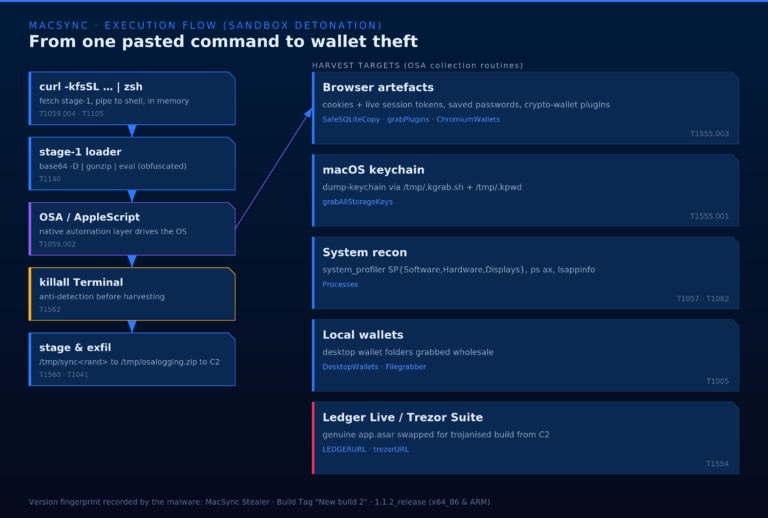
No exploit. No attachment. No phishing email. In this campaign the threat actor needs the victim to do exactly one thing: copy a command from an installation guide and paste it i…
Read article →
ABSTRACT The FBI recently issued an advisory on Kali365, a Phishing-as-a-Service platform that abuses legitimate Microsoft OAuth flows to bypass multi-factor authentication. Kali…
Read article →
Intelligence · Phishing Kit · Q1 2026 April 24, 2026Fortgale CTI14 min readRPT-26-0424 Observation of the quarter The 2026 phishing ecosystem has outpaced traditional defenses. M…
Read article →
In the high-stakes world of venture capital and corporate funding, where millions hang in the balance and sensitive financial data flows freely, a new breed of cyber threat is em…
Read article →
In February 2026, the Fortgale Incident Response team investigated a multi-stage intrusion attributed to Mora_001, a Russian-origin threat actor exploiting Fortinet vulnerabiliti…
Read article →
UPDATES: 27.11.2024: As mentioned by TrustWave, "Supercar Phishing Kit" has an high level of overlapping with the most recent update of "Rockstar 2FA Phishing-as-a-Service" 26.09…
Read article →24·7·365 monitoring from a European SOC, alert triage and validation, intel-driven detection and threat hunting mapped to MITRE ATT&CK, investigation, remote containment (median <30 min from confirmed alert), remediation guidance, the Defence Map and monthly reporting. For the basics, see what MDR security is.
The price depends on scope (endpoints, identities and data sources covered), on the service level and on optional add-ons. Fortgale prepares a written quote after the Discovery meeting; you can start from the quote request. Compared with an in-house SOC, MDR avoids hiring and retaining enough analysts to cover every shift: the math is in managed SOC vs in-house.
An MSSP typically manages security devices and forwards alerts, leaving the response to you. MDR takes on detection, investigation and containment: Fortgale analysts have the authority to act, not just to notify. The full comparison with EDR and XDR is in MDR vs EDR vs XDR.
It depends on the provider, so ask. Fortgale analysts contain on your behalf: they isolate hosts, revoke sessions and block accounts according to the agreed runbooks, with median containment <30 min from confirmed alert.
Organisations without a 24·7 security team, lean IT teams that cannot watch alerts at night, companies in regulated sectors under NIS2 or DORA, and those coming out of an incident who need continuous coverage quickly.
The SOC is the structure that monitors; MDR is the service that, on top of the SOC, adds intel-driven detection and above all response: analysts have authority to decide and contain, not just to notify. In the Fortgale model the managed SOC and MDR are the same European outpost, with no handover between providers.
Yes. The service is NIS2-ready: continuous monitoring, documented detection, IOC collection for the national CSIRT notification within 24 hours and the technical documentation for follow-up filings, aligned with ISO/IEC 27001, DORA and GDPR Art. 32.
Defence is active from day one: access and security monitoring go live within the first days of onboarding. Within three weeks from NDA, platform access is complete and the service is at full capacity. Five steps: Discovery, Onboarding, Provisioning, Federation, Full protection. No go-live event: protection grows from day 1.
Yes, the service is vendor-agnostic: it integrates on the platform you already use, or selects an optimal one with you. Fortgale runs MDR on Microsoft Defender, CrowdStrike Falcon, SentinelOne and 7 other leading platforms, all under a single console.
In Operation Storming Tide the Fortgale team detected and contained a multi-stage intrusion (actor Mora_001) at a European logistics organisation: data exfiltration and ransomware prevented.
Read the analysis →An AiTM attack against senior executives during an investment round was intercepted before compromise. No access was gained.
Read the case →Over 100 published analyses. Attributions corroborated by third parties such as Mandiant (Google), Amazon, SentinelOne and Huntress. European SOC, 24·7·365.
What is MDR → · Why MDR is more than a SOC → · MDR vs EDR vs XDR → · From MDR to MDIR →
We bring the Report on your sector with the most probable adversaries and a real MDR runbook mapped to your technology stack.
No nurturing sequences, no auto-replies. One of our analysts calls you back within one business day.
The full Report (executive summary · operational IoCs · technical runbook) is restricted. Share two details and one of our analysts contacts you with access and a short technical briefing.
Response in 30 minutes, containment in 1–4 hours. Even if you are not a Fortgale customer.