01 ·
Clinical continuity
Care does not stop. Fortgale MDR is designed to contain without shutting down critical clinical systems. We work alongside healthcare IT staff.
Healthcare organisations are NIS2 essential entities. When an incident halts a department, three clocks run together: clinical triage, the national CSIRT notification and the Data Protection Authority notification. Fortgale handles the three lines in parallel.
Healthcare is not just an industry with personal data: it is an essential service that cannot stop, with one of the most sensitive information assets (clinical data) under GDPR art. 9, and devices that stay in production for 10-15 years without patches.
Care does not stop. Fortgale MDR is designed to contain without shutting down critical clinical systems. We work alongside healthcare IT staff.
When a data breach hits clinical data, both obligations trigger: national CSIRT (24h/72h/30d) and Data Protection Authority (72h). Fortgale prepares the two notifications in parallel.
PACS, RIS, monitors, infusion pumps are not patched like IT endpoints. Segmentation, OT-aware passive monitoring and vendor access control with MFA jump hosts.
When an incident hits a healthcare organisation qualified as essential entity, three time-bound obligations trigger toward the national CSIRT, layered with the GDPR notification to the Data Protection Authority. Fortgale prepares the technical documentation for all notifications in parallel.
Organisation identification, incident description, systems involved, initial containment measures. National CSIRT portal.
Initial impact assessment, collected IoCs, containment measures activated. Same deadline for the DPA notification (GDPR art. 33).
Root cause analysis, attack vector, definitive impact, corrective measures, improvement plan. Defensive documentation in case of sanction.
LockBit, BlackCat, Rhysida have hit European hospitals. Department halts, ambulance diversion, surgery postponement.
Double extortion with publication on leak sites of reports, anamnesis, clinical photographs. GDPR sanction and severe reputational damage.
Phishing on accounting and procurement offices. Diverted wire transfers on pharmaceutical supplies and devices.
Known unpatched vulnerabilities on PACS, RIS, monitors. Pivot to clinical networks from exposed DICOM/HL7 brokers.
European SOC with senior team. MITRE ATT&CK-mapped detection, median containment <30 min.
Discover MDR →When the incident is in progress, Fortgale handles technical, communication, notification and recovery in a single flow.
Discover →Proprietary feeds on actors active against European healthcare: LockBit, BlackCat, Rhysida, BlackSuit.
Discover CTI →Healthcare organisations qualified as essential entities under NIS2 transposition must notify in three steps: early warning within 24 hours, intermediate notification within 72 hours, final report within 30 days. When the incident involves a personal-health-data breach, the Data Protection Authority must also be notified within 72 hours (GDPR art. 33). The two notifications are independent.
Qualified as essential: public and accredited private hospitals, analysis and reference laboratories, manufacturers of critical medical devices, drug distributors, clinical research organisations. Qualification depends on sector and size (medium and large enterprises, with exceptions for critical entities). Smaller organisations may fall under important or remain out of scope, but GDPR always applies.
Five parallel actions: (1) activate the clinical continuity plan to guarantee care; (2) isolate compromised systems without powering them off (to preserve RAM evidence); (3) notify the national CSIRT within 24 hours if NIS2 entity; (4) notify the DPA within 72 hours if personal data is involved; (5) start the technical incident response. Fortgale supports all five lines in parallel.
Medical devices (PACS, RIS, monitors, infusion pumps, IoMT) can rarely be updated like IT endpoints. Protection relies on: dedicated network segmentation (isolated healthcare VLANs), OT-aware passive traffic monitoring, vendor access control with MFA jump hosts, firmware and CVE inventory, perimeter hardening (IoMT gateways, DICOM/HL7 brokers), compliance with the MDR Regulation (EU) 2017/745 for the lifecycle.
Yes. NIS2 applies indistinctly to public and private healthcare sectors above size thresholds. Accredited private organisations are often critical suppliers of public health systems and fall in the same essential entity categories. GDPR applies equally to both. The difference concerns only internal procedures for appointing the cybersecurity officer.
We profile the ransomware gangs that have hit European healthcare facilities, TTPs, PHI exfiltration methods, attacks on the medical device supply chain. Research applied to the healthcare perimeter, from public health authorities to private institutions.
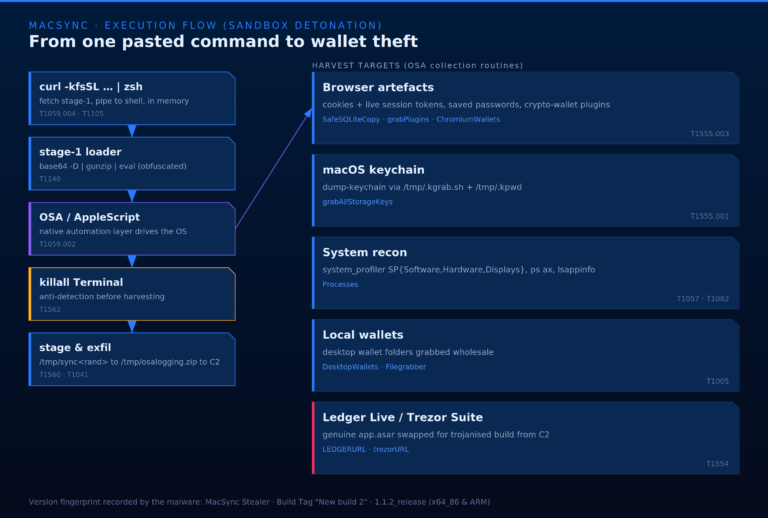
No exploit. No attachment. No phishing email. In this campaign the threat actor needs the victim to do exactly one thing: copy a command from an installation guide and paste it i…
Read article →
ABSTRACT The FBI recently issued an advisory on Kali365, a Phishing-as-a-Service platform that abuses legitimate Microsoft OAuth flows to bypass multi-factor authentication. Kali…
Read article →
Intelligence · Phishing Kit · Q1 2026 April 24, 2026Fortgale CTI14 min readRPT-26-0424 Observation of the quarter The 2026 phishing ecosystem has outpaced traditional defenses. M…
Read article →
In the high-stakes world of venture capital and corporate funding, where millions hang in the balance and sensitive financial data flows freely, a new breed of cyber threat is em…
Read article →
In February 2026, the Fortgale Incident Response team investigated a multi-stage intrusion attributed to Mora_001, a Russian-origin threat actor exploiting Fortinet vulnerabiliti…
Read article →
UPDATES: 27.11.2024: As mentioned by TrustWave, "Supercar Phishing Kit" has an high level of overlapping with the most recent update of "Rockstar 2FA Phishing-as-a-Service" 26.09…
Read article →Fortgale supports public and private European healthcare organisations in protecting clinical data, medical devices and continuity of care. From 24·7 MDR to the dual CSIRT + DPA notification, in a single operational flow.
No nurturing sequences, no auto-replies. One of our analysts calls you back within one business day.
The full Report (executive summary · operational IoCs · technical runbook) is restricted. Share two details and one of our analysts contacts you with access and a short technical briefing.
Response in 30 minutes, containment in 1–4 hours. Even if you are not a Fortgale customer.