
Italy Report: Microsoft Exchange
In March, Microsoft released a security bulletin for Microsoft Exchange patch deployment. The urgency of the patch was driven by evidence that the criminal group Hafnium was exploiting certain vulnerabilities to compromise servers across multiple organizations worldwide (CVE-2021-26855, CVE-2021-26857, CVE-2021-26858 and CVE-2021-27065).
During this period, new vulnerabilities in the Microsoft Exchange product were identified that would allow attackers to gain unauthorized access to these systems without knowledge of usernames and passwords.
Interactive Map
- Compromised Systems
- as of 29 March: 346
- as of 10 April: 245
- Systems with two or more backdoors:
- as of 29 March: 106
- as of 10 April: 72
- Exchange systems in Italy: 8 394;
- vulnerable systems:
- 1 477 on 29 March (17% of total);
- 1 100 on 10 April (13% of total);
Backdoors Installed on Italian Servers
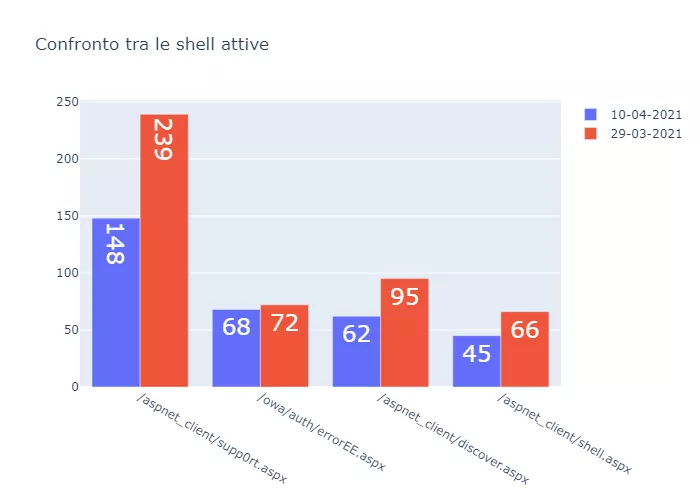
Between 29 March and 10 April, a clear reduction in the number of backdoors installed on compromised Italian systems is evident.
This is linked to patch deployment activities and concurrent backdoor removal. We emphasize that patch application alone is insufficient for effective removal of malicious code.
The backdoor supp0rt.aspx shows the largest decline and is the most prevalent in Italian systems. Initial compromises related to this backdoor date back to 5 March 2021.
Web Shell Status Codes
Interactive Image
Web Shell Paths
Interactive Image
Vulnerable Systems Assessment
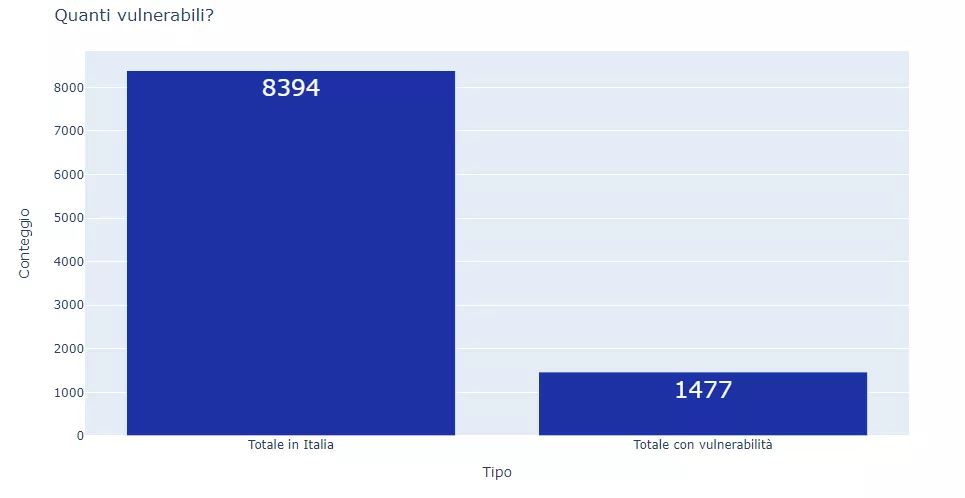
Vulnerable systems in Italy. Differences observed over two weeks.
Our team’s monitoring and analysis activities identified approximately 8 000 Microsoft Exchange systems in Italy. 1 477 were found to be vulnerable as of 29 March 2021.
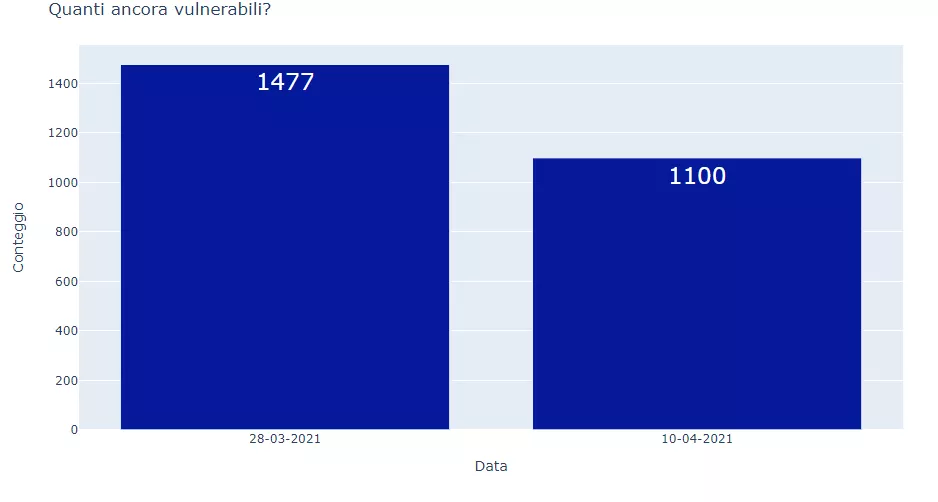
Follow-up assessment on 10 April identified 377 patched systems. 1 100 systems remained vulnerable. Through Cyber Threat Intelligence monitoring, we tracked the remediation pace across Italian infrastructure.
Cities by number of vulnerable systems:
Vulnerable systems by ISP (Internet Service Provider):
The Microsoft Exchange vulnerability campaign demonstrates the critical importance of rapid patch deployment combined with forensic validation. Patch application must be accompanied by comprehensive backdoor detection and removal procedures, as initial compromise vectors may persist through web shells deployed prior to patching. Organizations operating unpatched Exchange infrastructure remain exposed to T1190 (Exploit Public-Facing Application) and T1505.003 (Web Shell) attack chains, with TA0010 (Exfiltration) as the likely operational objective.